
Quick answer: Microsoft Certified: Azure AI Fundamentals is a beginner credential for understanding AI workloads and implementing foundational AI solutions with Azure and Microsoft Foundry. The current required exam is AI-901, which replaced older topic coverage with greater emphasis on modern generative AI tooling and practical foundational skills.
It fits students, early-career technologists, business professionals who work with AI teams, and developers beginning an Azure AI path. Microsoft expects conceptual AI knowledge plus foundational technical skills, including awareness of Python syntax, programming techniques, Azure resources, REST APIs, SDKs, and command-line tools.
Is Microsoft Certified: Azure AI Fundamentals worth it?
Good fit when
It fits students, early-career technologists, business professionals who work with AI teams, and developers beginning an Azure AI path. Microsoft expects conceptual AI knowledge plus foundational technical skills, including awareness of Python syntax, programming techniques, Azure resources, REST APIs, SDKs, and command-line tools.
Consider another route when
It is not evidence that a holder can design, train, secure, deploy, and monitor a production AI system independently. Candidates seeking an advanced engineering role need deeper mathematics, data, programming, evaluation, security, and operational experience beyond this fundamentals exam.
What Microsoft Certified: Azure AI Fundamentals covers
The official Microsoft material groups the credential around the following practical knowledge areas. Always use the live exam guide because providers can revise objectives. Read the official study guide.
- Identify common AI workloads, responsible-AI considerations, and solution constraints.
- Explain foundational machine-learning concepts in an Azure context.
- Recognize computer-vision and natural-language-processing capabilities.
- Understand generative AI workloads and Microsoft Foundry fundamentals.
- Connect basic implementation choices to Azure resources, APIs, SDKs, and tools.
Requirements and recommended experience
Use small exercises to connect concepts with tools. Explore an Azure AI workflow, inspect inputs and outputs, call a service through a guided interface or API, and document data, evaluation, safety, and cost considerations. The goal is foundational understanding, not simply memorizing product names.
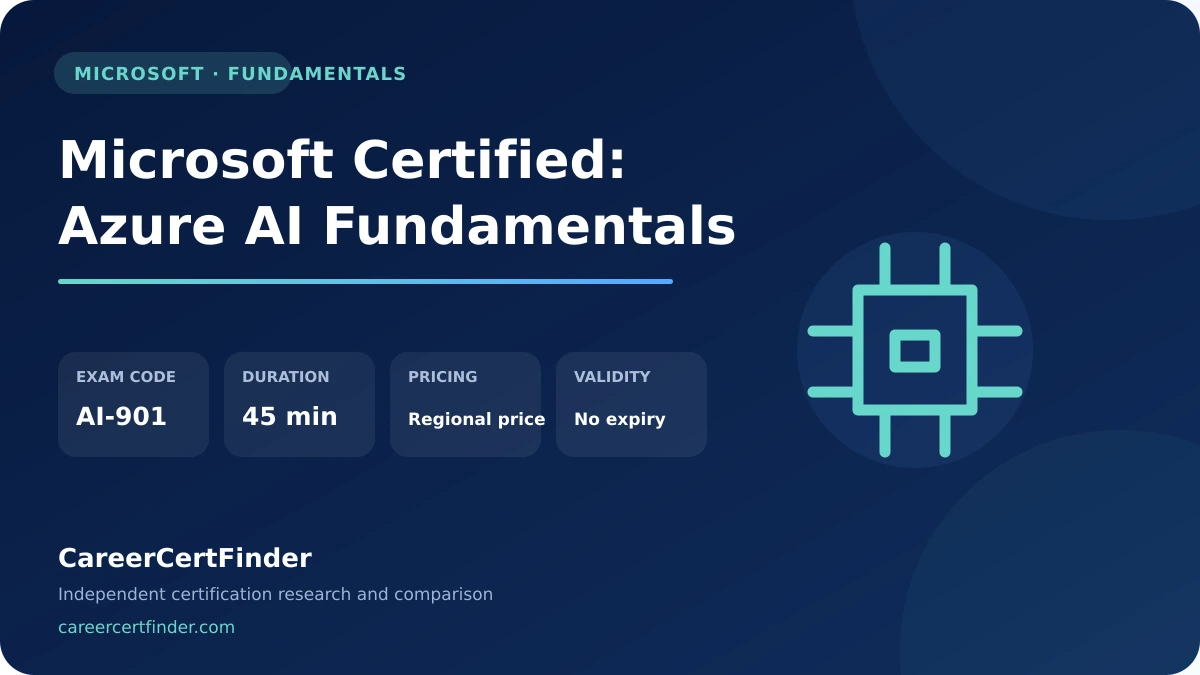
The current AI-901 assessment allows 45 minutes. Microsoft describes it as a proctored certification exam and lists pricing through a country or region selector. Language, scheduling, delivery, and objective details should be confirmed on the live exam page because this credential was updated in 2026. Confirm the current credential details.
How to prepare for Microsoft Certified: Azure AI Fundamentals
- Start with the current AI-901 study guide because older AI-900 outlines may not match the 2026 exam.
- Learn the concepts behind AI workloads before memorizing Microsoft product names or user-interface steps.
- Complete small guided exercises using Azure resources, APIs or SDKs, and record what the system can and cannot do.
- Use the current practice assessment to find weak areas, then revisit the official learning resources before booking.
A fixed number of study weeks would be misleading because prior experience varies. Schedule the assessment when you can explain the objectives, complete representative tasks, and diagnose mistakes without relying on memorized wording.
Cost, validity, and renewal
Microsoft prices the exam according to the country or region in which it is proctored, and the public credential page may not show one universal amount. Check the live scheduling flow for the exact local price, taxes, available discounts, and delivery choices before paying.
Validity: Microsoft Fundamentals certifications do not expire under the current expiration policy. Renewal: No annual renewal assessment is required for this fundamentals credential. Microsoft can still update or retire credentials as technology changes, so learners should rely on the current credential page when planning.
Career value and limitations
The certification can add structured AI vocabulary to an early learning plan and may help someone communicate more clearly with Azure AI teams. It is not a substitute for projects or job-ready engineering ability. A candidate should pair it with practical Python, data handling, model evaluation, responsible-AI, and deployment work appropriate to the target role.
Compare before you choose
Azure Fundamentals is broader if you first need cloud concepts. Azure Data Fundamentals is better for a data-first route. Candidates already building AI systems should compare role-based or applied credentials and choose based on the actual skills their target jobs require.
Use the Certification Finder to narrow the catalogue or open Compare Certifications to review credentials side by side.
Microsoft Certified: Azure AI Fundamentals FAQs
Is the exam code AI-900 or AI-901?
The current Microsoft credential page lists AI-901. Candidates should use the current AI-901 study guide instead of relying on older AI-900 preparation material.
Does Azure AI Fundamentals expire?
Microsoft states that Fundamentals certifications do not expire under its current credential expiration policy.
Do I need coding experience?
Microsoft now expects foundational technical skills and familiarity with Python syntax and programming techniques. This is not an advanced coding exam, but purely nontechnical preparation may be insufficient.
Will this qualify me as an AI engineer?
No. It is a fundamentals credential. AI engineering roles typically require applied programming, data, evaluation, deployment, security, and operational experience.
Credential at a glance
A useful literacy credential; it is not evidence that the holder can independently build production AI systems.
Eligibility and requirements
Education
No formal education requirement is stated on the reviewed official credential page; check eligibility details before applying.
Required experience
Microsoft does not publish a required number of professional-experience years. The current AI-901 profile expects conceptual Azure AI knowledge and foundational technical skills.
Prerequisites
No mandatory prerequisite certification is stated on the reviewed official page.
Recommended background
Python coding syntax, programming techniques, Azure resources, REST APIs, SDKs, CLIs, and core cloud concepts are useful preparation.
Exam and preparation
- Exam code
- AI-901
- Format
- The current AI-901 assessment allows 45 minutes. Microsoft describes it as a proctored certification exam and lists pricing through a country or region selector. Language, scheduling, delivery, and objective details should be confirmed on the live exam page because this credential was updated in 2026.
- Duration
- 45 minutes
- Passing score
- 700
- Delivery
- Use Microsoft’s exam scheduling flow; available delivery options can depend on region and account.
- Estimated study time
- Varies; use the current Microsoft Learn study guide and practice assessment.
Cost and renewal
- Validity period
- Does not expire
- Renewal requirements
- Microsoft Fundamentals certifications do not require renewal.
- Cost notes
- Exam price is based on the country or region where the exam is proctored; confirm the live checkout price.
Career outcomes
Relevant job roles
- AI-aware business professional
- Entry-level cloud learner
- Technology student
Provides introductory AI vocabulary and can support progression to role-based Azure credentials.
Salary ranges are estimates, vary by role and location, and are not employment guarantees.
Sources and verification
Last verified: September 2, 2026 · CareerCertFinder Research Desk
Microsoft and the named credential are trademarks of their respective owner. This is an independent informational listing with no provider endorsement. Requirements, fees, delivery, and policies can change; confirm the linked official source before purchase or publication.
Fees, exam policies, prerequisites, and renewal rules can change. Confirm current details with the issuing organization before registering or paying.