
Quick answer: AWS Certified Developer – Associate is a role-focused AWS credential covering the development, deployment, testing, security, optimization, and troubleshooting of cloud applications. Its strongest value is for people who already write software and want to show that they can use AWS services as part of a modern delivery workflow.
It fits software developers, cloud application developers, and DevOps-oriented engineers who work with SDKs, APIs, event-driven services, permissions, deployment pipelines, and observability. AWS recommends one or more years of experience developing and maintaining applications with AWS services.
Is AWS Certified Developer – Associate worth it?
Good fit when
It fits software developers, cloud application developers, and DevOps-oriented engineers who work with SDKs, APIs, event-driven services, permissions, deployment pipelines, and observability. AWS recommends one or more years of experience developing and maintaining applications with AWS services.
Consider another route when
It is not a general programming certificate and does not teach a programming language from the beginning. Someone who has never built, tested, or debugged an application may struggle with scenario questions even after memorizing service names. Architecture-only or operations-only roles may find a different AWS associate credential more relevant.
What AWS Certified Developer – Associate covers
The official Amazon Web Services material groups the credential around the following practical knowledge areas. Always use the live exam guide because providers can revise objectives. Read the official study guide.
- Develop applications with AWS APIs, SDKs, and managed services.
- Implement authentication, authorization, and least-privilege access.
- Package and deploy application changes through repeatable workflows.
- Use logs, metrics, traces, and error handling to diagnose problems.
- Optimize application performance while managing cost and service limits.
Requirements and recommended experience
Preparation should include real code. Build at least one small application that reads and writes data, invokes managed services, uses secure credentials, deploys through a pipeline, emits useful telemetry, and handles failures. The exact language matters less than understanding how application code interacts with AWS APIs and runtime services.
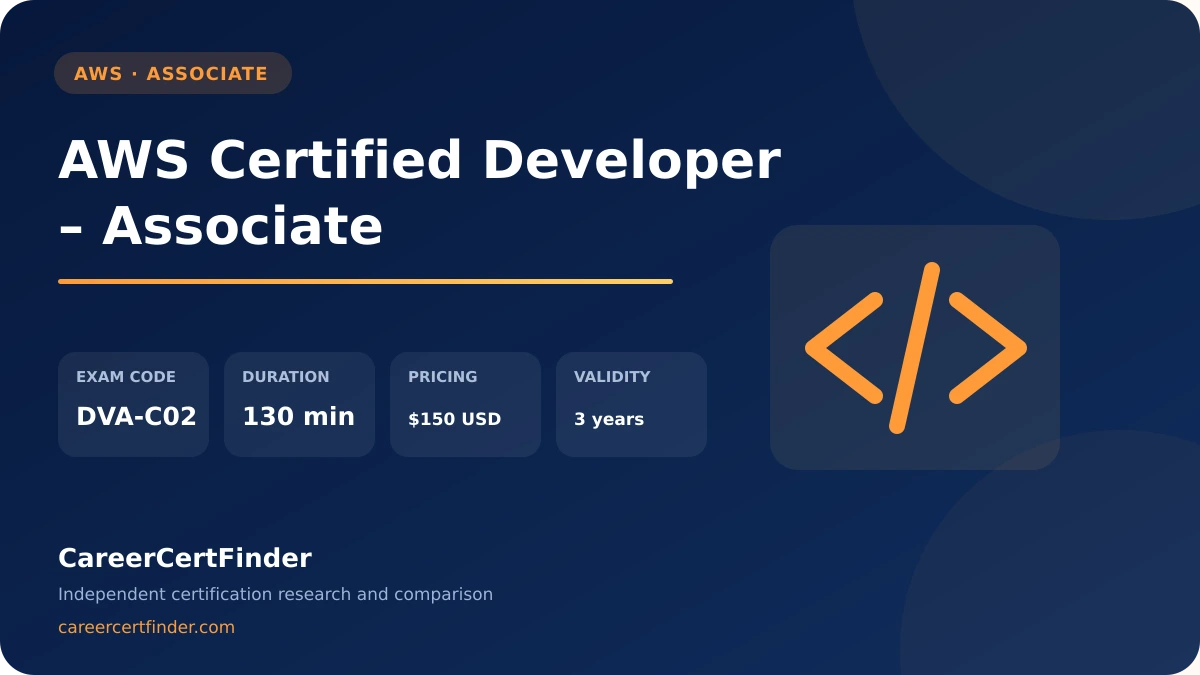
The DVA-C02 exam currently contains 65 multiple-choice or multiple-response questions with a 130-minute time limit. AWS offers Pearson VUE test-center or online-proctored delivery. Review the live exam page for languages, accommodations, identification, and scheduling policies. Confirm the current credential details.
How to prepare for AWS Certified Developer – Associate
- Map the current DVA-C02 exam guide to applications you have built and list the services or workflows you cannot yet explain.
- Create an application using authentication, data storage, messaging or events, deployment automation, and observability.
- Practice diagnosing permission failures, throttling, deployment errors, bad configuration, and incomplete telemetry.
- Finish with official exam-style questions, then use the results to guide targeted labs rather than repeated passive reading.
A fixed number of study weeks would be misleading because prior experience varies. Schedule the assessment when you can explain the objectives, complete representative tasks, and diagnose mistakes without relying on memorized wording.
Cost, validity, and renewal
AWS lists the exam at USD 150 before taxes and local currency adjustments. Budget separately for optional training, practice resources, cloud usage, and any retake. Existing AWS Certification holders may have a 50% discount voucher for a future exam in their certification account.
Validity: The certification is valid for three years. Renewal: AWS currently permits renewal by passing the latest Developer – Associate exam or AWS Certified DevOps Engineer – Professional for a three-year extension. Eligible candidates may also use the Skill Builder maintenance route for a one-year extension under the current subscription and timing rules.
Career value and limitations
This certification can support developer and cloud application pathways, but employers normally examine code quality, testing habits, system design, security choices, and delivery experience. A small public project or a clear walkthrough of a production contribution often adds more evidence than the badge alone. No employment or salary outcome is promised.
Compare before you choose
Choose Solutions Architect – Associate if you spend more time selecting architecture patterns than writing application code. Choose CloudOps Engineer – Associate if monitoring, incident response, backup, and infrastructure operations dominate your work. Cloud Practitioner is a gentler starting point for candidates without IT experience.
Use the Certification Finder to narrow the catalogue or open Compare Certifications to review credentials side by side.
AWS Certified Developer – Associate FAQs
Do I need professional AWS experience for AWS Certified Developer – Associate?
There is no formal experience gate, but AWS recommends one or more years of hands-on development and maintenance experience using AWS services.
Which programming language should I use?
Use a language supported by the AWS tools relevant to your work. The exam is about cloud application decisions and workflows, not proving mastery of one specific language.
Is DVA-C02 enough for a developer job?
No. Employers also need evidence of programming, testing, debugging, collaboration, version control, security awareness, and application delivery.
What should I take after this exam?
AWS presents DevOps Engineer – Professional as a common progression. Data Engineer – Associate can also fit developers moving toward data and machine-learning systems.
Credential at a glance
Useful for AWS application-development roles when paired with coding samples and deployment experience.
Eligibility and requirements
Education
No formal education requirement is stated on the reviewed official credential page; check eligibility details before applying.
Required experience
AWS recommends one or more years of hands-on experience developing and maintaining applications using AWS services.
Prerequisites
No mandatory prerequisite certification is stated on the reviewed official page.
Recommended background
Programming experience and familiarity with AWS SDKs, security, deployment, and observability are helpful.
Exam and preparation
- Exam code
- DVA-C02
- Format
- Multiple-choice and multiple-response questions.
- Questions
- 65
- Duration
- 130 minutes
- Passing score
- 720
- Delivery
- Pearson VUE testing center or online proctored exam
- Estimated study time
- Varies; combine the current exam guide with application-building practice.
Cost and renewal
- Exam fee
- $150
- Validity period
- 3 years
- Renewal requirements
- AWS currently permits renewal by passing the latest Developer – Associate exam or AWS Certified DevOps Engineer – Professional for a three-year extension. Eligible candidates may also use the Skill Builder maintenance route for a one-year extension under the current subscription and timing rules.
- Cost notes
- USD list price for one attempt; taxes and local-currency pricing can vary.
Career outcomes
Relevant job roles
- Cloud application developer
- Software engineer
- DevOps developer
Supports cloud-development pathways, with hiring value depending heavily on programming and delivery experience.
Salary ranges are estimates, vary by role and location, and are not employment guarantees.
Sources and verification
Last verified: September 2, 2026 · CareerCertFinder Research Desk
Amazon Web Services and the named credential are trademarks of their respective owner. This is an independent informational listing with no provider endorsement. Requirements, fees, delivery, and policies can change; confirm the linked official source before purchase or publication.
Fees, exam policies, prerequisites, and renewal rules can change. Confirm current details with the issuing organization before registering or paying.