
In this guide
- PMP vs PSM I: what does each option validate?
- PMP vs PSM I: side-by-side comparison for 2026
- Entry requirements in PMP vs PSM I
- PMP vs PSM I: assessment, difficulty and study time
- Cost and renewal in PMP vs PSM I
- Choose PMI Project Management Professional (PMP) when
- Choose Scrum.org Professional Scrum Master I (PSM I) when
- Can you use both without wasting time?
- 7-step decision and study plan
- PMP vs PSM I: portfolio and interview proof
- Frequently asked questions
- Verdict
- Official provider sources
Short answer: PMP vs PSM I compares two useful but different routes. Choose PMP for broader project leadership, governance, stakeholders, planning and hybrid delivery responsibilities. Choose PSM I for a focused Scrum Master path and evidence of precise Scrum framework knowledge. Choose the route that closes a verified skill gap and gives you evidence you can discuss in an interview.
This 2026 guide examines PMP vs PSM I through purpose, readiness, assessment, renewal, cost, study planning and practical proof. Provider rules can change after a guide is checked, so use the official links below before registering or paying.
Continue exploring: browse the Certification Guides or use the Certification Finder to compare more credentials.
PMP vs PSM I: what does each option validate?
PMI Project Management Professional (PMP) is an experience-based project-leadership certification across predictive, agile and hybrid environments. Its value is strongest when that scope matches the tasks named in target job descriptions. A badge alone does not show how well you can perform those tasks, so connect preparation to a small, explainable project.
Scrum.org Professional Scrum Master I (PSM I) is a focused assessment of Scrum theory, the framework and Scrum Master accountabilities. It can be the better signal when employers use its provider, framework or role language. Read the official objective or learning guide rather than relying on an old course outline.
The important distinction in PMP vs PSM I is scope. One option may teach or test a broader foundation while the other may emphasize a provider, method or job function. Write down the five recurring responsibilities in roles you want and map each responsibility to the current published domains.
PMP vs PSM I: side-by-side comparison for 2026
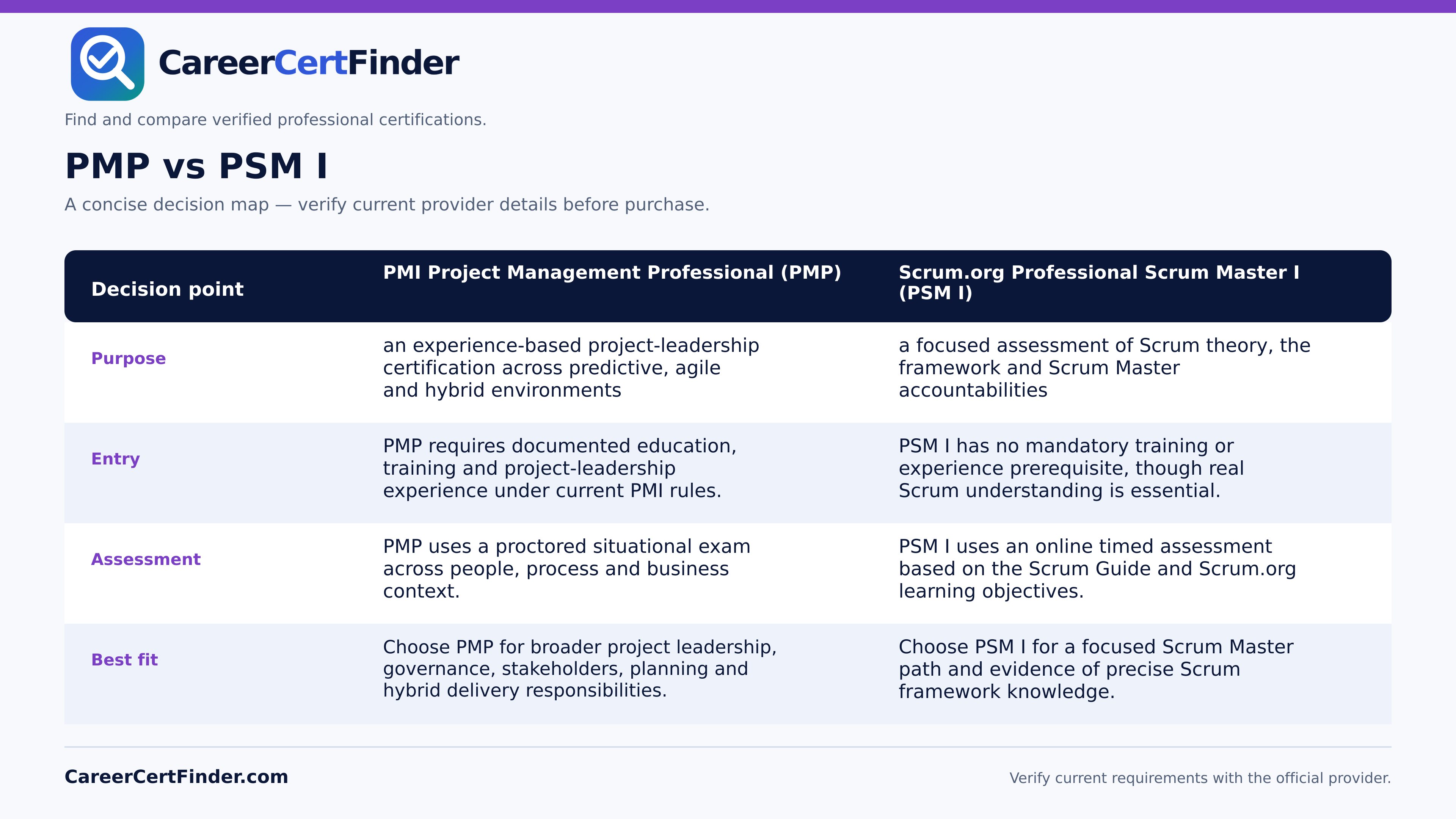
For a practical PMP vs PSM I decision, use this table as a map, then verify details for your country and exam date. The comparison avoids salary promises because location, experience and job performance matter more than a credential name.
| Decision point | PMI Project Management Professional (PMP) | Scrum.org Professional Scrum Master I (PSM I) |
|---|---|---|
| Primary purpose | an experience-based project-leadership certification across predictive, agile and hybrid environments. | a focused assessment of Scrum theory, the framework and Scrum Master accountabilities. |
| Readiness | PMP requires documented education, training and project-leadership experience under current PMI rules. | PSM I has no mandatory training or experience prerequisite, though real Scrum understanding is essential. |
| Assessment route | PMP uses a proctored situational exam across people, process and business context. | PSM I uses an online timed assessment based on the Scrum Guide and Scrum.org learning objectives. |
| Maintenance | PMP requires PDUs in each three-year cycle. | Scrum.org states that PSM I does not expire and does not require a renewal fee. |
| Best fit | Choose PMP for broader project leadership, governance, stakeholders, planning and hybrid delivery responsibilities. | Choose PSM I for a focused Scrum Master path and evidence of precise Scrum framework knowledge. |
| Practical proof | Analyze complex project scenarios and document stakeholder, delivery and risk trade-offs. | Facilitate simulated Scrum events and explain how empiricism and self-management change team decisions. |
Entry requirements in PMP vs PSM I
For PMI Project Management Professional (PMP), PMP requires documented education, training and project-leadership experience under current PMI rules. Treat a provider recommendation as a readiness signal even when it is not a formal gate. Take a baseline quiz, explain the main domains without notes and complete one practical task before buying anything.
For Scrum.org Professional Scrum Master I (PSM I), PSM I has no mandatory training or experience prerequisite, though real Scrum understanding is essential. If experience must be documented for the full credential, separate eligibility from exam preparation. Keep accurate records and never inflate a job title or project responsibility.
PMP vs PSM I readiness rule: you should be able to explain why an answer is correct, why plausible alternatives are wrong and how the concept changes a real decision. Memorizing a term list is not enough.
PMP vs PSM I: assessment, difficulty and study time
PMP uses a proctored situational exam across people, process and business context. Build a study tracker from the current provider blueprint. Mark each objective as explain, demonstrate or review, and attach a practice result or lab note to every weak area.
PSM I uses an online timed assessment based on the Scrum Guide and Scrum.org learning objectives. Compare the assessment style as well as the subject. A course sequence rewards consistent completion, while a proctored exam demands recall and judgment under time pressure. Performance items require safe hands-on rehearsal.
A realistic PMP vs PSM I study calendar depends on your starting point. Estimate study time after a diagnostic, not from a marketing promise. Plan in weekly outcomes: one domain review, one closed-book practice set, one practical exercise and one error-log session.
- Download the current official objective, study guide or course outline.
- Use a legal lab, sandbox or simulated case that you control.
- Record incorrect answers by concept and reasoning error.
- Book an exam only after repeated timed results are stable.
Cost and renewal in PMP vs PSM I
A complete PMP vs PSM I cost comparison uses total cost rather than the headline fee. Include training, subscription months, tax, exam voucher, practice tests, lab hosting, travel, retake risk and renewal. Regional prices and bundles change, so record the checkout amount on the day you decide.
For maintenance, PMP requires PDUs in each three-year cycle. By comparison, Scrum.org states that PSM I does not expire and does not require a renewal fee. Add renewal dates and continuing-education work to the decision before you commit.
A sensible PMP vs PSM I budget reserves time for practice after the credential. Finishing a badge with no project, reflection or interview story often produces less career value than a slower route with strong evidence.
Choose PMI Project Management Professional (PMP) when
Choose PMP for broader project leadership, governance, stakeholders, planning and hybrid delivery responsibilities. Confirm the choice by finding at least ten relevant vacancies in your intended location. Count how often the credential, its underlying skills and its provider appear. Skills listed repeatedly matter even when the badge is optional.
Your practical companion should be specific: Analyze complex project scenarios and document stakeholder, delivery and risk trade-offs. Save a short problem statement, steps, result and lessons learned. Remove secrets, personal information and proprietary data before sharing any evidence.
Choose Scrum.org Professional Scrum Master I (PSM I) when
Choose PSM I for a focused Scrum Master path and evidence of precise Scrum framework knowledge. Check whether employers ask for the full credential, an exam pass, a course certificate or simply the related skills. Those are not interchangeable claims.
Pair preparation with this task: Facilitate simulated Scrum events and explain how empiricism and self-management change team decisions. Be ready to explain trade-offs and mistakes. A clear explanation of a modest project is more credible than a complex project you cannot defend.
Can you use both without wasting time?
For PMP vs PSM I, These are different scopes. A project manager using Scrum may study both, but should avoid treating Scrum Master as a renamed project-manager role. The second option should add a new role, platform or level of judgment. If it repeats most of the same foundation, direct that time to supervised work, labs or communication practice instead.
When reviewing PMP vs PSM I, make a two-column skills matrix. Highlight true overlap, mark the gaps required by target roles and choose the shortest ethical route to close those gaps. Do not buy the second credential just because the first is complete.
7-step decision and study plan
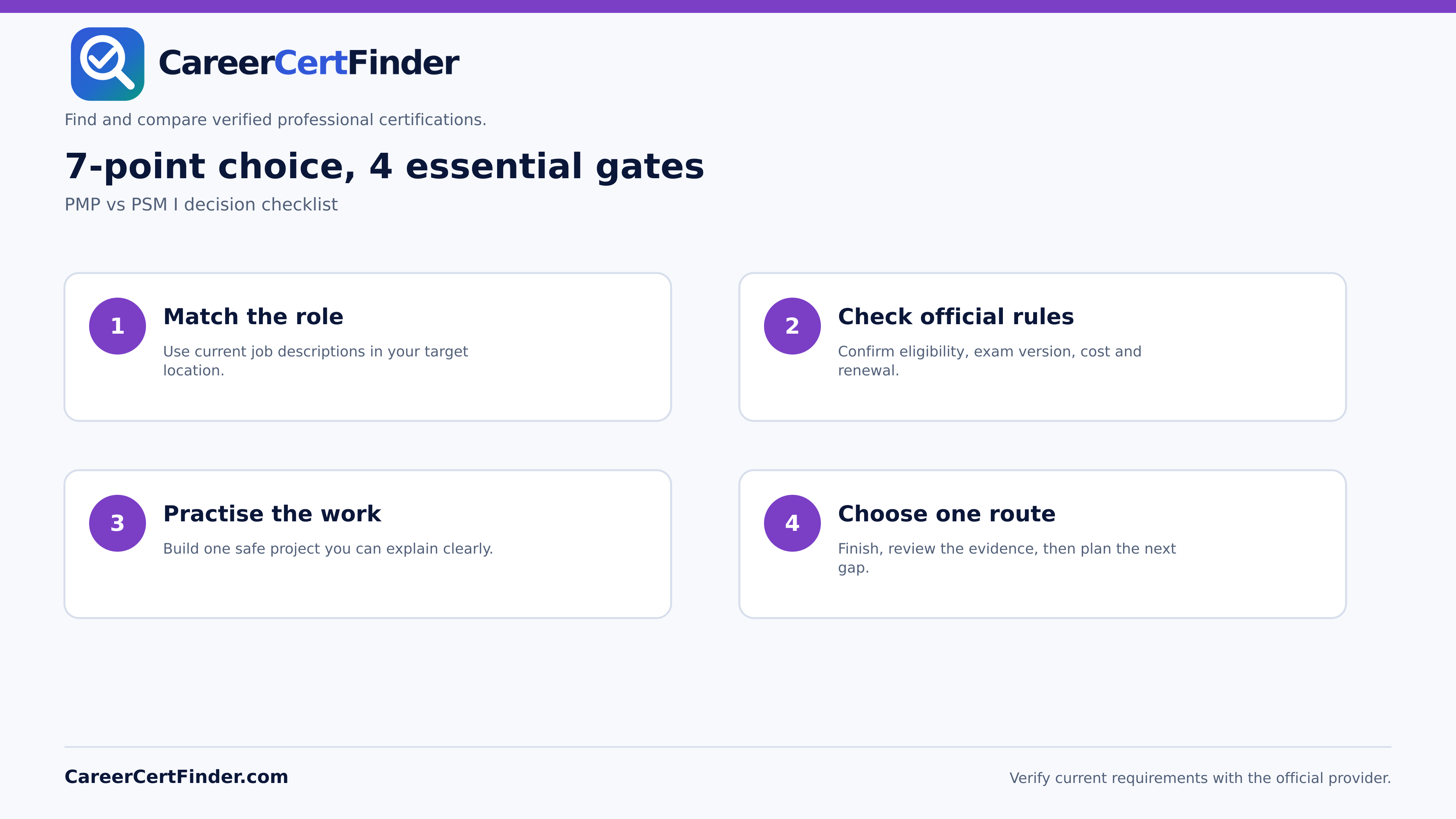
Use this PMP vs PSM I checklist before enrolling:
- Define one target role. Save ten current job descriptions from the location and work arrangement you want.
- Audit eligibility. Check education, experience, training, identity and testing requirements on official pages.
- Map the domains. Link every published objective to a job task, a learning resource and a form of practice.
- Run a diagnostic. Use provider samples or reputable practice questions without memorizing answer dumps.
- Price the full route. Include taxes, subscriptions, labs, retakes, travel and renewal rather than only the exam fee.
- Build proof. Complete one safe project and write what you chose, tested, learned and would improve.
- Set a review gate. Publish or schedule your exam only when evidence and timed results meet a written standard.
PMP vs PSM I: portfolio and interview proof
Analyze complex project scenarios and document stakeholder, delivery and risk trade-offs. For the other route, Facilitate simulated Scrum events and explain how empiricism and self-management change team decisions. Each artifact should state its scope and whether it is a simulation, course exercise or real authorized work.
Choose according to accountabilities in real job descriptions, not the shorter or cheaper exam. Explain one setback, how you investigated it and what evidence changed your mind. That story demonstrates judgment and integrity, which a score report cannot.
After completing either option, update your résumé precisely. Use “earned,” “completed” or “passed” only when accurate, include the provider and date, and do not imply licensed authority, employment or experience that the credential does not grant.
Frequently asked questions
Which is better in PMP vs PSM I?
In PMP vs PSM I, there is no universal winner. Choose PMP for broader project leadership, governance, stakeholders, planning and hybrid delivery responsibilities. Choose PSM I for a focused Scrum Master path and evidence of precise Scrum framework knowledge. The better option is the one supported by your eligibility, target jobs and access to practice.
Can a beginner start with either option?
For PMP vs PSM I, use the official entry guidance, then test yourself. If one route assumes experience you do not have, learn the foundations and create safe practice evidence first. Eligibility to sit an exam does not automatically mean the exam is the best first step.
Should I earn both credentials?
These are different scopes. A project manager using Scrum may study both, but should avoid treating Scrum Master as a renamed project-manager role. Earn both only when the second closes a documented gap or is required for a real opportunity. Avoid collecting overlapping badges without deeper work.
Verdict
The practical verdict on PMP vs PSM I is to match scope with work. Choose PMP for broader project leadership, governance, stakeholders, planning and hybrid delivery responsibilities. Choose PSM I for a focused Scrum Master path and evidence of precise Scrum framework knowledge. Whichever path you choose, use current provider materials, practise ethically and produce one piece of evidence you can explain without notes.
Sources and scope: facts checked September 8, 2026. Exam versions, prices, eligibility, delivery and renewal policies can change. Confirm every material detail with the provider before payment.